
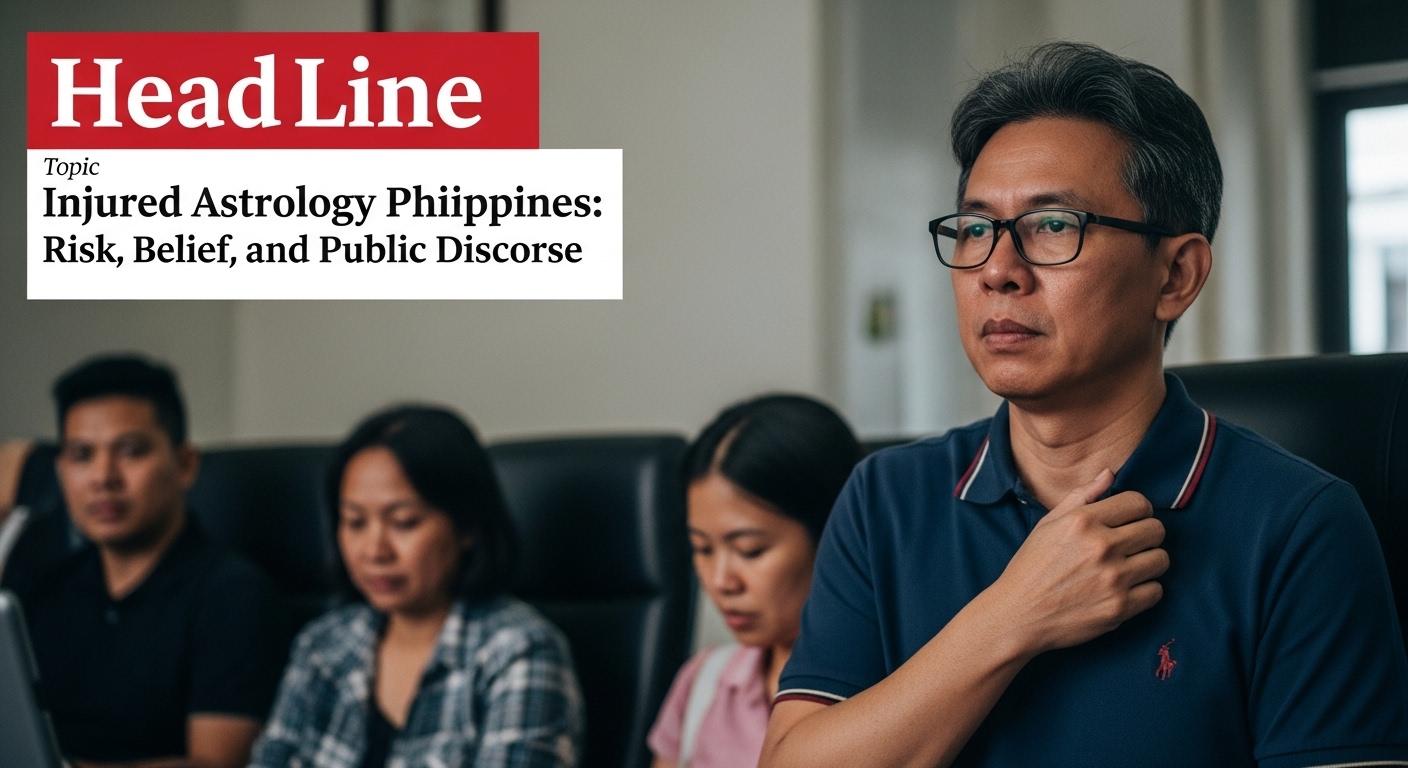
Philippines newsroom editorial desk with astrology charts and screens
Updated: April 8, 2026
Across Philippine online spaces, the phrase injured Astrology Philippines has crept into discussions about safety, chance, and fate. This article treats it not as a sensational trope but as a window into how astrology enters journalism, social media, and everyday risk assessments in a country that blends skepticism with a long tradition of zodiac and planetary beliefs. By tracing how audiences react to reported injuries and disasters through a celestial lens, we map the causal links between belief systems, communication practices, and policy attention. The objective is to understand what this keyword signals about credibility, cultural identity, and practical risk communication in the Philippines.
Shifting narratives in a crowded information environment
In 2024 and 2025, Philippine audiences encountered a surge in astrology-based commentary that migrates from horoscope sections to the dynamics of public risk. When a local incident is reported—whether a transportation accident, workplace injury, or natural hazard—social feeds often juxtapose official updates with celestial readings. This is not simply entertainment; for some readers it acts as a heuristic in the absence of rapid, bite-sized official data. The result is a dual track: official reporting that emphasizes verifiable facts and timelines, and interpretive threads that relate the event to personal fate, planetary alignments, or cyclical patterns. This dual track can shape attention, influence what questions citizens ask, and affect how stakeholders gauge urgency.
Media teams increasingly encounter audience expectations shaped by online cultures that reward immediacy and resonance. The presence of a keyword like injured Astrology Philippines in comments or trending posts signals a demand for explanations that blend accuracy with cultural narrative. Editors who recognize this tendency can design coverage that respects both the scientific baseline and the symbolic language communities use to understand risk. The key is to anchor astrology as context—an interpretive frame—rather than a claim of causation or a replacement for official data.
Astrology and risk perception in the Philippines
Astrology remains a meaningful part of the cultural fabric in many Philippine communities. For some readers, forecast-like statements provide a tool for coping with uncertainty, rhythm for daily planning, and a sense of belonging in a crowded metropolis or countryside. While this does not negate the value of science or journalism, it does require reporters and editors to explain how such beliefs interact with risk communication. A report on an injury or accident can be strengthened by offering clear timelines, preventive context, and links to safety guidelines, while acknowledging the readers’ need to interpret the event through culturally salient lenses.
Critical audiences also demand transparency about sources and methodology. When astrology-derived interpretations appear in coverage, outlets should differentiate between personal reflections, community traditions, and data-driven updates. By outlining what is known, what is speculation, and what remains uncertain, journalists can reduce misinterpretation and help readers separate belief from evidence. The Philippines, with its diverse languages and regional dialects, presents a particular challenge and opportunity: astrology can be a shared frame across communities, yet it must be contextualized for each audience segment.
Media framing, misinformation, and regional nuance
The regional dimension matters. Urban centers such as Manila or Cebu may encounter faster-paced social feeds and a wider variety of astrology content, while rural areas might rely more on community radio and word-of-mouth networks where ritual calendars and superstition hold sway. Coverage that respects this diversity while maintaining standards of verification and fairness can prevent the conflation of astrology with causality. Inaccurate or sensational interpretations—such as attributing injuries to celestial signs without evidence—can undermine public trust and complicate emergency communications.
Philippine media literacy initiatives increasingly emphasize source attention, confirmation practices, and the use of plain language in safety advisories. Pairing astrology-informed discussions with accessible explanations about risks, protective measures, and official guidance can help audiences navigate uncertainty without dismissing cultural nuance. The ultimate aim is to preserve plural voices while ensuring that critical information—like evacuation orders, hazard alerts, or medical instructions—reaches diverse readers in appropriate languages and formats.
Actionable Takeaways
- Explicitly label astrology-based commentary as interpretation or cultural context, not as evidence of causal mechanisms.
- Provide verifiable safety information alongside any narrative that references celestial timing or zodiac cycles.
- Offer clear sources, official updates, and data-driven context in every report about injuries or risk events.
- Tailor communication to regional languages and media habits to reach rural and urban audiences alike.
- Encourage readers to verify claims from multiple credible sources and practice media-literacy habits when consuming online commentary.
Source Context
The following sources illustrate how risk narratives, journalism, and global perspectives intersect with local Philippine discourse. They are offered for background and transparency: